

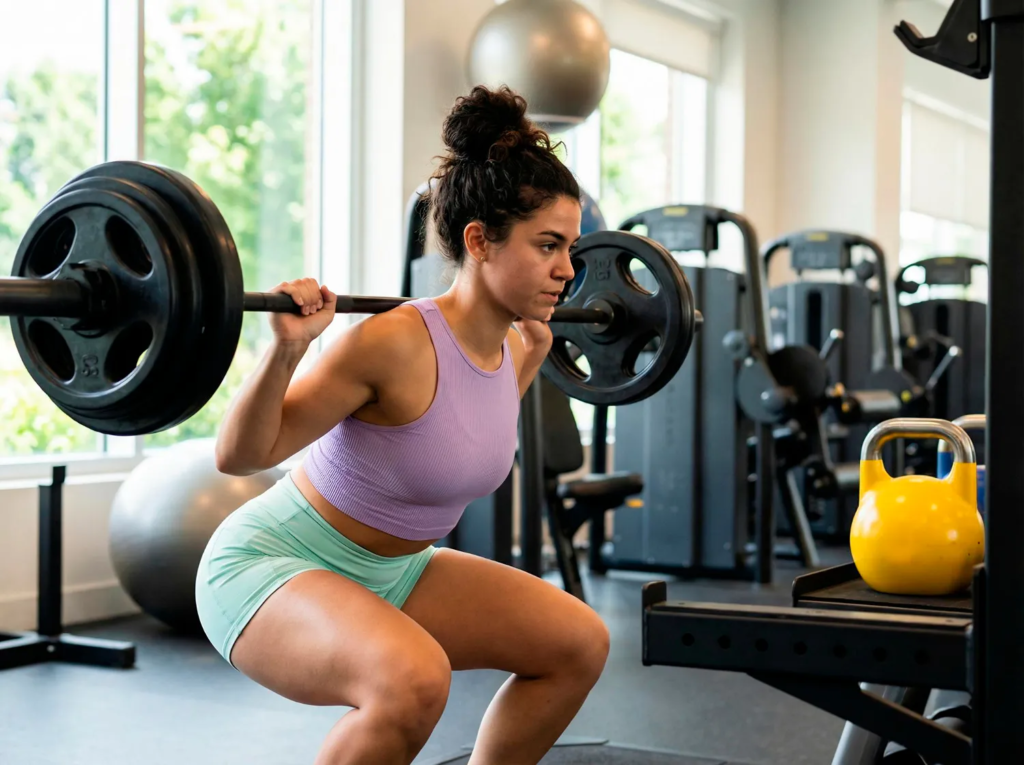
Mile three on the Dry Canyon trail. Legs feel good. Lungs feel great. And then you feel that familiar warm trickle running down your thighs. It’s inconvenient and embarrassing.
Or it’s the box jumps in the 6 a.m. class. You’ve started hanging back during double-unders. You tell yourself it’s a rest break. But you know the truth. Fear of leaking during that movement is real.
You’ve done the research. You do Kegels at red lights. You bought the black leggings. Someone on the internet told you to quit running until it stops, and someone else told you to just squeeze harder.
Here’s the thing: fit women don’t usually leak because the pelvic floor is weak. They leak because the pressure system around it is out of sync, and squeezing harder can actually make that worse.
Why Strong Women Leak
Your pelvic floor is the bottom of a pressure canister. The diaphragm is the lid, the deep abdominals are the walls, and the pelvic floor is the base. Every stride, every lift, every jump pushes pressure down through that canister.
When the system works, the base responds a split second before the pressure lands. Think of a trampoline that gives and springs back. When the base is already pulled taut, or shows up late, the pressure has nowhere to go but out.
That’s why “strong” and “leaking” live comfortably in the same body. Your pelvic floor isn’t lazy. It’s badly timed, or it’s gripping so hard it has nothing left to give.
Five Reasons Fit Women Leak (and None of Them Is “Weak”)
Your pelvic floor is tight, not weak
The most common pattern in runners and lifters is a pelvic floor that never fully relaxes (hypertonicity, if you’d like the clinical word). A muscle held at 80 percent all day can’t produce a quick, strong contraction when a 200-pound landing shows up. A muscle that can’t let go doesn’t need to grip harder.
You’re holding your breath to brace
Breath-holding (the Valsalva, a word that sounds like a yoga retreat) works great for a one-rep max. It’s a terrible strategy for 30 wall balls. When you hold your breath, you lock the lid of the canister and shove all the pressure toward the base. Your pelvic floor is now a doorstop.
You’ve been sucking your stomach in since middle school
Pulling your belly in flat all day pushes pressure down and keeps the pelvic floor on duty. It feels tidy. Disciplined. Protective. It’s also the posture equivalent of never putting the grocery bag down.
Your hips and glutes are clocking out
The pelvic floor isn’t a solo act. Glutes, deep hip rotators, and adductors share the load on every landing. When the hips are stiff or underpowered (hello, desk job plus trail runs), the pelvic floor picks up overtime it was never meant to work.
The timing is off, not the strength
Impact leaks happen in a very specific window: the instant your foot hits the ground. If your pelvic floor fires a tenth of a second late, you leak, no matter how many Kegels you’ve done. Timing is trainable. Most women have never been shown how.
Why “More Kegels” and “Stop Running” Are Both the Wrong Answer
More Kegels on a tight pelvic floor is like tightening the ropes on a tent that’s already pulled so taut the stakes are lifting. Kegels aren’t wrong. They’re just often incomplete, and for a tight pelvic floor they’re the wrong first step. So no blanket Kegel prescription from me.
“Stop running until it stops” has a different problem: it never stops on its own, because rest doesn’t teach timing. You lose fitness, you lose the thing that keeps you sane, and the leak is waiting for you at mile three when you come back.
The barre instructor said tuck. The CrossFit coach said brace. Peloton said drive through the legs. Twelve cues. Zero plans.
It’s common. That doesn’t mean it has to be your normal.
What Actually Helps
- Exhale on effort. Breathe out as you lift, land, or push. The exhale lets the diaphragm rise and the pelvic floor respond instead of absorbing a pressure slam.
- Stop sucking in. Let your belly move with your breath between sets and on easy miles. A pelvic floor that gets a break can show up when it matters.
- Warm up the pelvic floor like any other muscle. Ninety seconds of slow breathing with full let-go on the inhale, then a few quick lifts and releases, before your first stride or first set.
- Build hips and glutes on purpose. Split squats, side-lying hip work, single-leg bridges. Boring. Effective. Your pelvic floor will notice the help.
- Progress load, don’t flip a switch. Go from walking to walk-run intervals, from hops to single jumps to double-unders. Each step should be dry before you earn the next.
- Check cadence and shoes. A slightly quicker step rate and a shoe you haven’t run 600 miles in both reduce the force your pelvic floor has to catch. Small change, surprisingly big difference.
How you know you may be ready for impact again
A reasonable checkpoint before adding jumping or running: you can walk briskly for 30 minutes, hold a single-leg balance for 10 seconds each side, do 20 single-leg calf raises and 20 squats without leaking or heaviness, and jog in place for a minute dry. Not perfect. Just a starting line. If you’re unsure or believe other factors are involved, book an appointment with me or a trusted provider who can go over your symptoms and make a plan.
When to See Your Doctor First
Check in with your doctor if the leaking started suddenly without a clear reason, if you have blood in your urine, burning or pain with peeing, pelvic pain that isn’t tied to exercise, a new feeling of a bulge or something falling out, numbness in the saddle area, or leaking that keeps getting worse despite changes. A reasonable question to ask is “Could this be anything other than a pelvic floor issue, and would a pelvic floor PT referral make sense?” I work alongside your doctor, not instead of them.
What to Do This Week
- Film yourself. Ten seconds of your squat or landing from the side. Watch for breath-holding and a belly that never moves.
- Practice the exhale. Five bodyweight squats, exhaling on the way up. Then try it on the first set of your next workout.
- Add a 90-second pelvic floor warm-up. Breathe, let go, lift, release. Before every run or lift this week.
- Swap one high-impact piece. Step-ups for box jumps, single-unders for doubles. Temporary, not forever.
- Note the pattern. When you leak, write down the move, the rep, and whether you were holding your breath. It’s valuable information for your care provider.
Get an Actual Answer About Why You Leak
An evaluation tells apart a tight pelvic floor from a weak one, a timing problem from a strength problem, and a hip issue wearing a pelvic floor costume. Then you get a plan that keeps you running, lifting, or jumping while you fix it.
Not sure whether what you’re feeling is worth a visit? Start with the free 2-minute self-check. It won’t diagnose you, but it will tell you whether what’s happening during your workouts is worth a closer look.
If you’ve been quietly sizing up every box jump and dreading mile three, let’s find out what’s actually going on. Book an appointment and get back to finishing the workout without checking your shorts. A pelvic floor evaluation takes one hour, one-on-one, in a private room in Redmond or virtually anywhere in Oregon or California. No referral needed.
Keep reading: 7 Signs Your Pelvic Floor Is Too Tight (and Why More Kegels Make It Worse) and Still Wearing Liners for Leaks?