

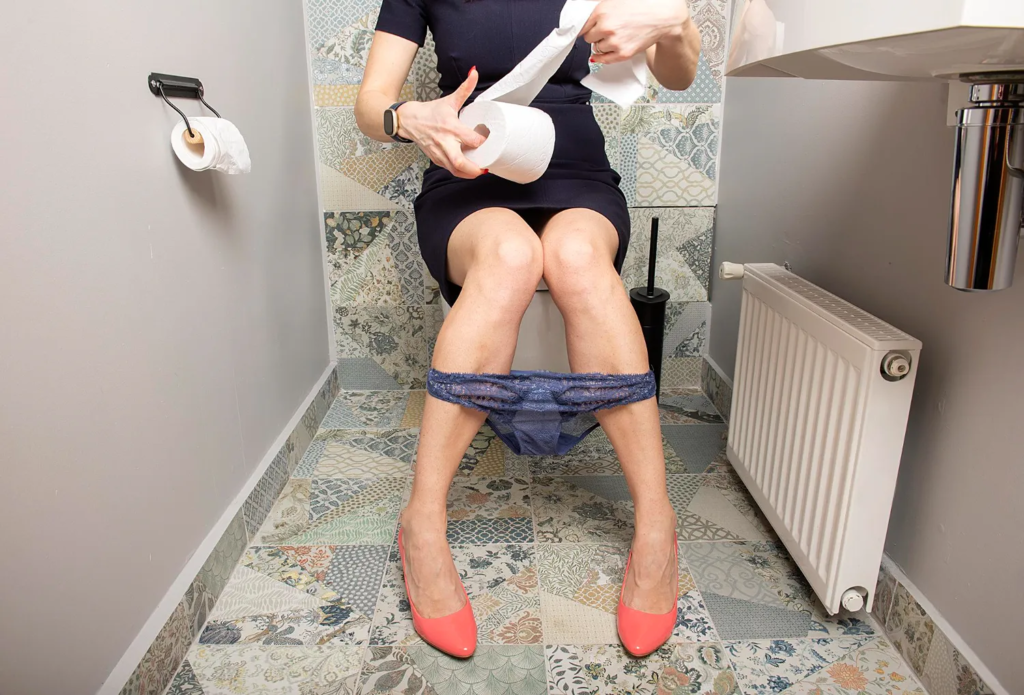
Be honest. You’ve turned around and looked. Maybe you’ve even wondered, “Is that… normal?” and then flushed and moved on with your day, because who exactly are you supposed to ask?
Us. You’re supposed to ask us. Your body sends you a little progress report every day, and it’s telling you more about your pelvic floor than you might think.
Meet the Bristol Stool Chart
Healthcare providers use something called the Bristol Stool Chart, a seven-point scale that runs from hard, separate lumps to entirely liquid. (Yes, there’s an official chart. Medicine is very glamorous.)
You don’t need to memorize all seven types. Here’s what you need to know:
- Types 1–2 (hard, dry lumps that are difficult to pass): constipation
- Types 3–4 (sausage-shaped, smooth or with a few surface cracks, easy to pass): the target. This is what a well-functioning system produces.
- Types 5–7 (soft blobs to entirely watery): the loose end of the scale, from a little under-formed to full-on diarrhea
Type 4 is the goal most days. Not every single time. Your gut is allowed an off day after taco night.
How Your Poop Connects to Your Pelvic Floor
Your pelvic floor muscles have two opposite jobs: hold everything in until you’re ready, then fully relax to let it out when you are. Both ends of the Bristol scale make those jobs harder.
Hard Stool and Straining (Types 1–2)
Passing hard stool takes a fully relaxed pelvic floor. If those muscles can’t let go, you end up pushing against them, and that repeated straining is a real risk factor for pelvic organ prolapse, hemorrhoids, and worsening pelvic floor problems over time. It isn’t just uncomfortable in the moment. It adds up, wearing on the same structures that support your bladder, uterus, and rectum.
Loose Stool and Urgency (Types 6–7)
Loose or watery stool asks the opposite: quick, strong closure, often on very short notice. If those muscles are weak or not well coordinated, urgency and even leaking become much more likely.
What Normal Actually Looks Like
How often you go matters less than you’d think. Anywhere from three times a day to three times a week can be normal. What matters more is that it’s usually a type 3 or 4, comes out without much straining, doesn’t leave you feeling like there’s more to go, and doesn’t require you to plan your day around bathroom access.
“That’s just how I’ve always gone” is one of the most common things we hear. Often, it describes years of straining, incomplete emptying, or urgency that has simply been normalized instead of addressed.
What Actually Helps
Fiber and Water, Together
Fiber helps hard stool from the input side, and most adults do well gradually working up to 25 to 35 grams a day. The key word is gradually, and it needs enough water alongside it. Fiber without enough fluid can make things worse, not better. (Just ask anyone who went from zero to three bran muffins overnight.)
Get a Footstool (the Other Kind of Stool)
Toilet posture matters more than most people expect. Rest your feet on a small stool so your knees are above your hips, lean forward, and let your belly relax. This puts your pelvic floor in its most cooperative position for letting go. It’s a cheap, simple change with a real mechanical effect.
Don’t Rush, Don’t Wait, Don’t Camp Out
Straining to beat the clock and ignoring the urge because it’s inconvenient both work against your body’s natural rhythm. And that 20-minute phone scroll on the toilet isn’t doing your bottom any favors either. Go when you need to, take the time you need, then get on with your day.
When to See a Doctor First
Some changes need a medical checkup before anything else: blood in your stool, black or tar-like stool, a lasting change in your usual pattern, unexplained weight loss, or severe abdominal pain. If any of these apply to you, see your doctor to rule out other causes.
When to See a Pelvic Floor Therapist
If you regularly strain, feel like stool gets stuck even when it’s soft, deal with frequent urgency or occasional leaking, or have honestly never known whether your pattern is normal, a pelvic floor evaluation can show how well these muscles are coordinating. From there, you get a plan that goes further than diet changes alone.
If your bathroom habits have quietly become something you work around, that’s worth a real conversation. Book an appointment and let’s talk about it. No judgment, no awkwardness (okay, maybe a little), just answers.